


Marcus had spent four years building his digital marketing agency. He had a solid roster of small business clients, a team of three, and a reputation in his local market for reliable SEO work. But every growth conversation felt the same: the prospect wanted more revenue, couldn't articulate what marketing channels were actually working, and hesitated at every proposal because they didn't understand what they were buying.
Then he discovered something that changed his sales process entirely. Instead of leading with his service menu, he shared a private link that walked the prospect through a guided growth assessment. The prospect received an automated gap analysis, saw their customer acquisition cost projections, and downloaded a bespoke 12-month marketing plan before Marcus ever pitched anything. By the time they got on a call, the prospect already understood their situation. The sales conversation shifted from "why should I hire you?" to "which of these scenarios makes sense for us?"
Marcus didn't change his services. He changed the first step.
Why Traditional Agency Sales Feels Broken
The agency sales process has a fundamental mismatch at its core. Business owners seeking marketing help typically arrive with three problems: they don't know which channels will work for their specific situation, they don't trust marketing agencies because they've been burned before, and they don't want to commit significant budget before seeing a coherent plan.
Traditional agency sales addresses none of these. It leads with services SEO packages, ad management retainers, content retainers before the client understands why they need those specific services. This puts the cart before the horse in the most literal sense: the prospect is being asked to buy tactics before they understand their own growth architecture.
Jason Swenk, an agency advisor who has scaled two agencies from zero to eight figures and works with brands including AT&T and Hitachi, has documented this dynamic extensively. In his framework for agency growth, Swenk emphasizes that agencies must "identify and communicate a growth vision" before positioning their services. This isn't a soft suggestion it's the structural gap that determines whether a prospect converts or ghosts after the discovery call.
For digital marketing agencies, scaling to over $1 million in revenue is complex and intricate. It requires implementing sound processes to build trust, sell your services, and generate leads. Jason Swenk, Agency Mastery 360
The challenge, as Swenk frames it, is that most agencies sell tactically (here's what we do) more than strategically (here's what your growth looks like if we do it right). The agency that can demonstrate strategic clarity first wins the trust needed to close higher-value engagements.
The Plan-Before-Sell Framework: Starting With Clarity Instead of Commitment
The concept behind plan-before-sell is straightforward: instead of asking prospects to buy services upfront, give them a free, useful starting point that helps them understand their marketing situation. This isn't a lead magnet in the traditional sense no gated whitepaper, no generic ebook. It's a personalized growth assessment that produces real deliverables: an automated gap analysis, one to three customer acquisition cost projections, and a bespoke 12-month marketing plan.
The mechanism that makes this work at scale is the private link. A growth-focused agency or practitioner can share a single, branded URL that initiates the guided process. The prospect enters their business context, answers a structured set of questions, and receives a complete planning document before any sales conversation occurs. This creates what practitioners call a "consultative front-end offer" something genuinely useful that naturally positions the sharing party as a trusted advisor beyond a vendor.
The plan-before-sell approach works because it addresses the three core fears business owners have about hiring agencies: fear of unclear ROI, fear of wasting budget on wrong channels, and fear of commitment before understanding. When a prospect receives their gap analysis and 12-month plan, those fears are substantially addressed before the sales call begins. The conversation shifts from persuasion to collaboration.
Gap Analysis and CAC Projections: The Numbers That Change Everything
If the plan-before-sell framework is the philosophy, gap analysis and customer acquisition cost projections are the concrete deliverables that make it persuasive. These aren't abstract concepts they're specific numbers that help business owners understand where they are and where they could be.
A gap analysis in this context examines the difference between a business's current marketing performance and its theoretical potential. It identifies which channels are underperforming, which are working but underinvested, and which represent the highest-leverage opportunities for the next 12 months. The output is a clear, prioritized list of what to address and in what sequence.
Customer acquisition cost projections take this further by quantifying the financial implications of different growth scenarios. A business owner might see three paths: a conservative approach focused on organic SEO and referral optimization, a moderate approach that adds paid acquisition, and an aggressive approach that layers multiple channels together. Each path shows projected CAC, expected conversion rates, and estimated revenue impact over 12 months.
When a prospect sees these projections before talking to an agency, they arrive at the sales call with context. They've already done the math on whether growth is worth the investment. The agency doesn't have to justify its fees they're simply discussing which scenario to implement.
This approach directly addresses the objection cycle that derails most agency proposals. Ethan Welby, founder of the Agency Growth Partner, has observed that agencies struggle most with "unpredictable sales and cashflow" and "speaking to the wrong prospects." Both problems are symptoms of the same root cause: the sales process starts with the agency's pitch instead of the client's situation. Plan-before-sell flips this sequence entirely.
Building Predictable Client Acquisition: The Daily-Monthly-Quarterly Rhythm
The plan-before-sell framework addresses the front end of client acquisition, but agencies also need systems that keep the pipeline full. Research from practitioners who have scaled agencies to seven figures consistently points to a daily-monthly-quarterly rhythm that maintains consistent lead flow without burning out the founder.
At the daily level, the most reliable pipeline builder is consistent outbound activity not random outreach, but systematic connection-building in a defined niche. Josh Nelson of Seven Figure Agency, whose methodology has helped numerous agencies reach seven-figure revenue, recommends daily cold outreach as a foundational habit: "You need to get a list of prospects in your niche and start reaching out to them. Send a message with a value-add in your introduction." Done daily over months, this builds a database of prospects who already know, like, and trust the agency before the first sales conversation.
Monthly activities amplify this foundation. Hosting a monthly webinar on a topic relevant to the target audience creates a recurring content asset that can be repurposed across channels. An expert interview-style podcast, published monthly, positions the agency founder as a voice of authority in the niche. These activities fill the pipeline with warm prospects people who have consumed the agency's content and arrived at the sales conversation already pre-positioned to buy.
Quarterly, the focus shifts to relationship deepening and case study creation. Attending industry events, conferences, and trade shows as an exhibitor or speaker creates high-value connections that generate referrals for months afterward. Creating new case studies featuring client results transforms satisfied clients into marketing assets that fuel the next quarter's outreach.
The KPI that ties this together, according to the Seven Figure Agency methodology, is a minimum of 15 strategy sessions per month. With a target 30% close ratio which Nelson identifies as achievable with a "great consultative sales process" this generates four to five new clients monthly. At typical agency retainers, this growth rate compounds into seven-figure revenue within 12 months.
How Hello.bz Implements the Plan-Before-Sell System for Its Agency Partners
The private link mechanism described above is the core delivery vehicle for the plan-before-sell system on Hello.bz. Agency partners and practitioners who join the platform receive a branded, customizable link that they can share across all channels: outreach emails, one-pagers, LinkedIn messages, referral partner communications, and website CTAs.
When a prospect clicks the link, they enter a guided process that produces the deliverables discussed above: automated gap analysis, CAC projections, and a 12-month marketing plan. The process is designed to be consultative and low-pressure the prospect sees their own growth situation clearly before deciding whether to engage with the agency partner.
What makes this particularly useful for the Hello.bz audience practitioners who may be solopreneurs, consultants, coaches, advisors, or referral partners is that the system requires no fulfillment infrastructure. Practitioners with access to business owners can offer this planning process without building a full-service agency. They share the link, stay the trusted source, and earn markup on any services the prospect ultimately purchases.
For practitioners who want to offer more marketing services without hiring, the plan-before-sell system provides a scalable front-end that doesn't require operational backbone. The planning process is automated; the fulfillment can be handled through white-label partnerships or selective contractor relationships.
The platform supports this through several complementary capabilities: white-label fulfillment for agencies that want to deliver services without building their own delivery teams, dashboard and reporting tools that keep clients informed of progress, sales playbook resources that help practitioners navigate the transition from planning to proposal, and partner onboarding processes that get new partners productive quickly.
Client Success Systems: Retention as Important as Acquisition
Scaling an agency isn't just about winning new clients it's about keeping them. Research from practitioners focused on agency growth consistently shows that the most successful agencies invest heavily in client success systems that deliver systematic excellent onboarding, ongoing communication, and predictable results reporting.
The Agency Growth Team, which specializes in placing and training client success managers for digital marketing agencies, frames this as the third bottleneck agencies face after appointment setting and sales. "Stuck in day-to-day work" describes an agency where the founder is wearing every hat including the client relationship hat which prevents both scaling and quality control. Building a systematic client success function allows the agency to deliver consistently without the founder's daily involvement.
For practitioners using the plan-before-sell system, this means the 12-month marketing plan isn't just a sales document it's a delivery roadmap. When clients receive their plan, they should see not just what channels will be activated but how results will be measured, reported, and optimized over time. Dashboard and reporting tools that provide real-time visibility into campaign performance transform the plan from a document into a living engagement.
The Revenue Model: Earning Markup Without Operational Drag
One of the most compelling aspects of the plan-before-sell system for practitioners is the revenue architecture it enables. Traditional agency models require significant operational investment: hiring specialists for each service channel, building project management infrastructure, managing client communications across multiple touchpoints. The plan-before-sell approach allows practitioners to generate revenue from client relationships without becoming a fulfillment machine.
This "earn markup without operational drag" model works through several mechanisms. The private link and automated planning process creates a sales mechanism that doesn't require the practitioner to deliver the services personally. White-label fulfillment partnerships allow agencies to offer comprehensive service packages while outsourcing delivery to specialized teams. Referral and partnership agreements can be structured so that the practitioner earns revenue for facilitating introductions and managing relationships without handling tactical execution.
For practitioners who want to add a new revenue stream without operational drag, this model provides a path that doesn't require building a traditional agency infrastructure. Consultants, coaches, advisors, and niche experts who have relationships with business owners can leverage those relationships into recurring revenue by offering the planning process and facilitating service delivery through trusted partners.
Attracting High-Paying Clients: Positioning and Offer Architecture
Agencies that consistently attract high-paying clients share a common trait: they position themselves around outcomes, not services. "We do SEO" is a service positioning. "We help B2B SaaS companies reduce their customer acquisition cost by 40% while scaling from $2M to $10M ARR" is an outcome positioning. The plan-before-sell system naturally supports outcome positioning because it leads with the client's growth situation more than the agency's capabilities.
Jason Swenk's eight-step framework for scaling agencies to eight figures emphasizes this distinction throughout. The early steps focus on crafting an irresistible offer that positions the agency as an expert authority, which then generates consistent sales calls. The mechanism isn't just about being confident it's about demonstrating strategic understanding before discussing tactical execution.
For practitioners, this means the private link isn't just a sales tool it's a positioning tool. When you share a link that produces a 12-month marketing plan, you're demonstrating that you understand growth architecture at a strategic level. This attracts clients who are looking for strategic partners, not just tactical executors. And strategic partners pay premium rates.
What This Means for Hello.bz Readers
For readers researching agency growth systems, the practical takeaway is straightforward: the most effective client acquisition mechanism starts with the prospect's situation, not the agency's services. A private link that produces gap analysis, CAC projections, and a 12-month marketing plan creates a consultative front-end that builds trust before the sales conversation. This approach is particularly valuable for practitioners who want to monetize business relationships without building operational infrastructure the plan-before-sell system can be delivered without fulfillment overhead, while the white-label fulfillment capability allows offering comprehensive services when clients are ready to proceed.
The daily-monthly-quarterly pipeline rhythm documented by practitioners who have scaled agencies to seven figures provides a complementary operational framework that keeps the pipeline full while maintaining reasonable founder workload. Combined with systematic client success systems that deliver consistent results and ongoing value, these components create a sustainable growth architecture that doesn't depend on the founder's personal effort for every deliverable.
Where to Read Further
- The complete Agency Growth System overview on Hello.bz covers the full platform capabilities and partner onboarding process.
- Josh Nelson's Seven Figure Agency Methodology details the daily-monthly-quarterly pipeline rhythm that keeps lead flow consistent.
- Jason Swenk's eight-step framework for scaling agencies to eight figures provides a comprehensive positioning and operations guide.
- Ethan Welby's Agency Growth Partner program addresses the three core bottlenecks appointment setting, sales, and day-to-day operations that keep agencies stuck.
- The partner onboarding resources on Hello.bz explain how new practitioners can get started with the plan-before-sell system in their first week.
- For practitioners interested in delivering comprehensive services without building their own fulfillment team, the white-label fulfillment capabilities provide operational infrastructure on demand.
- The sales playbook resources help practitioners transition smoothly from planning conversations to proposal conversations with qualified prospects.
Summary: The Agency Growth System at a Glance
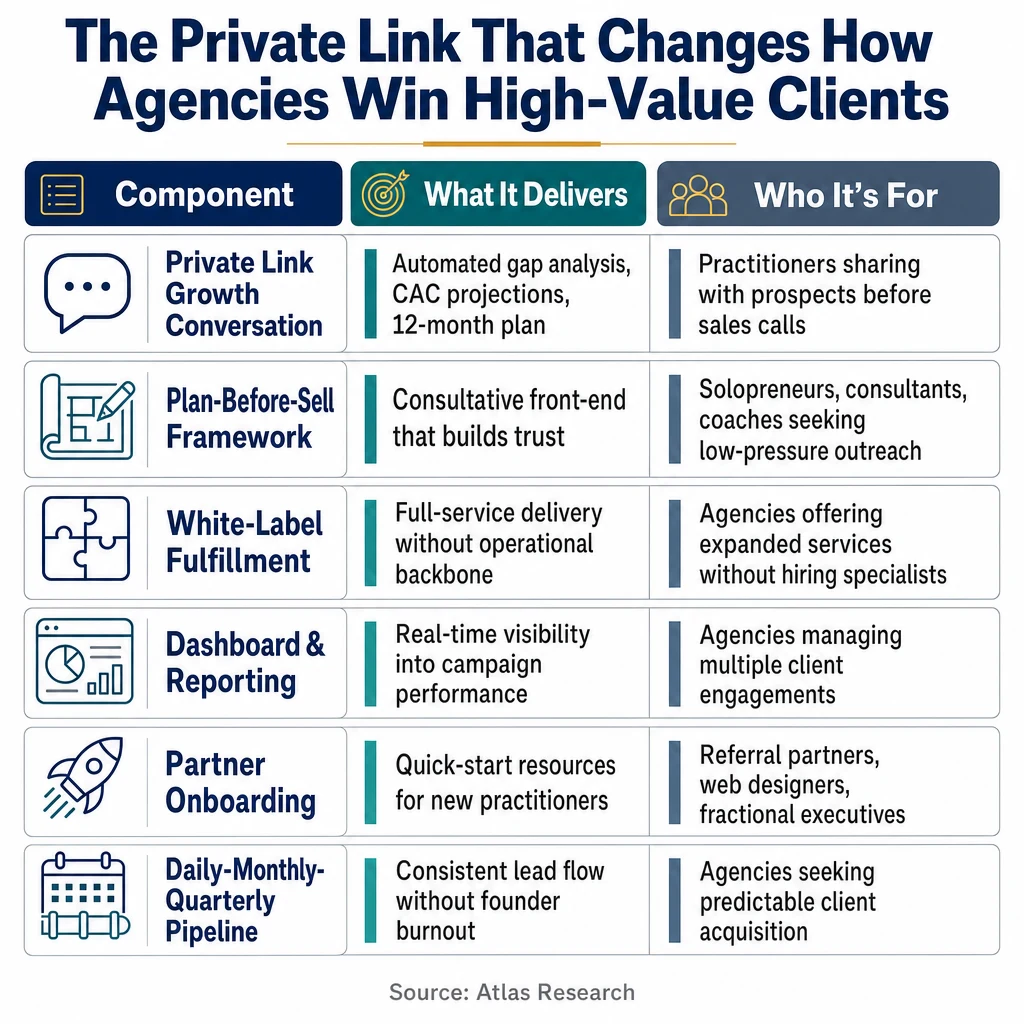
| Component | What It Delivers | Who It's For |
|---|---|---|
| Private Link Growth Conversation | Automated gap analysis, CAC projections, 12-month plan | Practitioners sharing with prospects before sales calls |
| Plan-Before-Sell Framework | Consultative front-end that builds trust | Solopreneurs, consultants, coaches seeking low-pressure outreach |
| White-Label Fulfillment | Full-service delivery without operational backbone | Agencies offering expanded services without hiring specialists |
| Dashboard & Reporting | Real-time visibility into campaign performance | Agencies managing multiple client engagements |
| Partner Onboarding | Quick-start resources for new practitioners | Referral partners, web designers, fractional executives |
| Daily-Monthly-Quarterly Pipeline | Consistent lead flow without founder burnout | Agencies seeking predictable client acquisition |
The agency growth system that works isn't the one with the most services or the lowest prices. It's the one that helps prospects understand their growth situation before asking them to commit. The private link that produces a 12-month marketing plan shared before the sales call, embedded in the onboarding process, referenced throughout the client relationship creates a foundation of strategic clarity that makes everything else easier.
Marcus, the agency owner from the opening scene, now shares his private link in every outreach message, every LinkedIn connection request, and every referral introduction. His conversion rate on discovery calls has increased substantially. Not because he changed what he offers, but because he changed what prospects see first.