


Savvy investors are increasingly bypassing the expired domain auction market, opting instead to directly negotiate with domain owners. While expired domains were once a prime source for branding opportunities, rising auction prices and unpredictable outcomes are driving a shift towards proactive outreach. This strategy offers greater control, potentially lower costs, and access to domains that never even reach the open market. Direct negotiation is quickly becoming the preferred method for securing premium domain names.
Then she found a freshly dropped four-letter .com that had been verified available thirty seconds earlier. She registered it before the hour was out. No auction. No backorder. No premium markup. Just a clean hand-registration at standard price.
This is the story the domain industry doesn't always tell straight. The conventional wisdom says short, brandable .com domains are a closed market grabbed years ago, now traded through brokers at prices that make startups flinch. But the reality, for anyone willing to look past the auction house and into the drop pipeline, is more interesting. And the tools that have emerged to navigate that pipeline have quietly changed what "finding a domain" actually means.
Why Short Domains Still Matter More Than Ever
The case for brevity in domain names isn't just aesthetic. It has roots in how the brain processes information. Research cited in domain industry analysis points to Miller's Law the idea that working memory can hold roughly seven, plus or minus two, chunks of information at once. A short domain occupies fewer of those chunks, making it easier to recall, type, and share. Studies in cognitive processing have shown that shorter names are recognized faster, which translates into what researchers call processing fluency the sense that a brand is trustworthy and familiar before you've even visited the site.
That fluency matters in concrete ways. Fewer characters mean fewer opportunities for typos, which means less traffic lost to misspellings or typosquatters. On mobile devices, where screens are small and keyboards are cramped, a short domain fits better in a URL bar, a text message, or a social media bio. In a noisy room, if you can tell someone your domain and they can remember it after one listen, that's a short domain passing a real-world test.
The economics reinforce the logic. According to sales data tracked by domain industry observers, two-letter .com domains have sold for an average of $150,000 or more, with some exceeding $1 million. Three-letter .coms average between $10,000 and $50,000. Four-letter .coms typically range from $1,000 to $10,000, with pronounceable names commanding the higher end. Five-character .coms settle into a $500 to $5,000 band. These aren't arbitrary numbers they reflect what buyers have consistently been willing to pay for the recall, credibility, and mobile-friendliness that brevity provides.
The Scarcity Myth and Where It Falls Apart
Here's the contrarian part. The standard narrative frames short .com availability as a closed door. Every two-letter combination is gone. Every three-letter combination is registered. Four-letter combinations are largely accounted for. The market, the story goes, has moved to brokers and auctions, and if you want a short domain, you're paying a premium.
That framing isn't wrong, exactly. It's incomplete. What it misses is the churn. Domains expire every day. Registrars release them back into the market on staggered schedules. Some of those expiring names are short, brandable, and clean and they become available again at standard registration prices before the aftermarket ecosystem has had time to reprice them. The window is narrow, but it exists.
The challenge is that traditional domain search tools weren't built to catch that window. Most registrars show you whether a name is available right now, but they don't show you what's about to become available, what just dropped, or how a name scores across the lenses that matter for branding. That's the gap that newer tools have started to fill.
How DomainKicks Approaches the Hunt
DomainKicks positions itself as a search layer on top of existing registrars a tool that checks availability across multiple sources simultaneously and surfaces what you can actually register right now, at the TLD's standard price. The platform uses live DNS verification across registrars including Dynadot and Name.com, and covers more than 800 TLDs, from the familiar .com and .net to the more specialized .ai, .io, .app, and .dev.
What makes the approach notable for the short-domain hunt is the Just Kick'd feature. This section of the platform shows domains that have just become available freshly dropped, verified live, and ready for hand-registration at standard TLD pricing. The emphasis on "no back-orders, no mark-ups, no hidden fees" is deliberate. It's a contrast to the aftermarket experience, where a name that was available at retail price yesterday can carry a premium the moment it enters a broker's inventory.
The Goldlist takes a different angle. It's a daily curated list of available premium domains, scored across four lenses: Fundable (framed as the venture capital angle), Resale (for domain investors), Brand (for naming purposes), and Future (for founders thinking ahead). Each entry is verified as buyable at hand-registration price, and the list can be filtered by TLD, length, lens score, or keyword. The four-lens scoring system gives hunters a structured way to evaluate whether a short name fits their specific goal, rather than relying on a single gut feeling about whether a name "sounds right."
The platform also offers a thesaurus-driven search mode that lets users generate domain ideas by specifying prepend and append options, controlling root words, and filtering across the full TLD library. For someone hunting for a short, brandable name, this means the search itself becomes part of the creative process not just a validation step after the idea is already formed.
"Your domain is your digital handshake. A short, memorable domain is the difference between being instantly recognizable and instantly forgotten." Domain Drake analysis on short domain strategy
Beyond .com: The Case for Alternative TLDs
One of the more useful reframes in the domain hunt is the suggestion to look beyond .com when short names are the goal. The math is straightforward: there are 676 possible two-letter .com combinations, 17,576 three-letter combinations, and 456,976 four-letter combinations. Every single one of those is registered. But the newer TLDs .ai, .io, .app, .dev, .co have vastly better availability for short names, and some of them carry semantic weight that .com lacks.
A name like "kova.app" or "zune.dev" might be available at standard registration prices names that would cost thousands on .com. The .ai extension has become particularly associated with artificial intelligence companies, which means a short .ai domain can signal category membership without requiring a long, generic .com. The .io extension has strong roots in the developer and tech startup community. These aren't compromises they're context cues that can work in a brand's favor.
The Invented Word Path
Another strategy that the domain hunt literature consistently returns to is coining new words. Think of names like Hulu (4 letters), Roku (4 letters), or Etsy (4 letters). These were available once because they didn't exist as English words. The inventors combined consonants and vowels in unusual but pronounceable ways, creating names that were short, memorable, and because they were novel available.
The advantage of this approach is that it sidesteps the scarcity problem entirely. If you're inventing a word, you're not competing with the existing registry. The challenge is that not every invented word lands well it has to feel like it could be a word, roll off the tongue, and look good on a business card. But for founders who are building something genuinely new, a coined name can be the cleanest path to a short, available domain that nobody else has claimed.
Non-English words offer another avenue. Short terms from other languages that are easy for English speakers to pronounce can yield available domains that would be taken if they were English words. The key is pronunciation if someone can hear the name once and type it correctly, it's a candidate.
What DomainKicks Readers Should Know
For readers coming to DomainKicks specifically, the platform's approach to the short-domain hunt has a few features worth understanding. The real-time verification across multiple registrars means you're not relying on a single source's cache the availability check reflects the current state of the registry, not a potentially stale database entry. The Just Kick'd section is updated as domains drop, giving hunters a way to catch freshly available names before they get repriced by the aftermarket. The Goldlist's four-lens scoring provides a framework for evaluating whether a short name fits a specific use case, whether that's attracting investors, building a resale position, or establishing a brand identity from scratch.
The practical workflow for a startup founder looking for a short, brandable domain would look something like this: start with the Goldlist to get a sense of what's currently available at standard pricing, use the thesaurus search to generate candidates that fit a specific keyword or concept, run those candidates through the real-time availability check, and then if a name is still available register it immediately before the window closes. The DomainKicks articles section offers deeper guides on domain valuation, risk auditing, and the technical steps needed after registration, including DNS configuration and email authentication standards like SPF, DKIM, and DMARC.
Evaluating a Short Domain Before You Buy
Not every short domain is worth registering, even when it's available. The domain industry literature emphasizes a few evaluation criteria that are particularly relevant for short names. First, check whether the name is pronounceable if you have to spell it twice over the phone, that's a signal. Second, check whether the name is already associated with unrelated brands, old junk pages, or spammy history. A domain that looks clean at first glance might carry baggage from a previous owner, and that baggage can affect email deliverability, search rankings, and brand perception.
Third, consider the extension fit. A short .com is still the most versatile option, but a short .io or .ai might be more appropriate for a tech startup, while a short .app might suit a software company. The extension is part of the brand signal, and matching it to the business context matters more than the conventional wisdom that .com is always the answer.
DomainKicks' articles section includes a risk assessment framework for evaluating domain purchase value, covering technical standing, legal risk, and investment logic. For founders who are new to domain buying, these guides offer a structured way to move from "this name looks good" to "this name is worth buying," without relying solely on intuition.
Where to Read Further
For readers who want to go deeper on the strategies discussed here, the DomainKicks articles section offers practical guides on buying better domains, including frameworks for domain valuation, expired-domain risk checks, and the technical essentials of DNS and email authentication. The Domain Drake analysis on shortest available domain names provides a detailed walkthrough of search tools and advanced filters for hunters focused on ultra-short names. And the domhaul breakdown of short domain values offers sales data and cognitive psychology context for understanding why brevity commands premium prices.
FAQ
How do I find available short brandable domain names?
The most effective approach combines real-time availability checking with tools that surface freshly dropped domains. Platforms like DomainKicks verify availability across multiple registrars simultaneously and feature sections like Just Kick'd that show domains that have just become available. Using thesaurus-driven search to generate candidates, then filtering by length and TLD, gives hunters a structured way to find short, brandable names that are available for hand-registration at standard pricing.
What makes a domain name brandable?
A brandable domain is typically short, pronounceable, memorable, and easy to spell from hearing. It should feel like it could be a word, carry positive connotations, and work across contexts on a business card, in an email address, on a mobile screen. Invented words that follow pronounceable patterns, short non-English words, and concise versions of existing words can all be brandable. The key is that the name doesn't require explanation; it lands on its own.
Are 4-letter .com domains still available to register?
Some are. While the majority of four-letter .com combinations are registered, domains expire every day and re-enter the market. The Just Kick'd section on DomainKicks shows freshly dropped domains that are verified available at standard registration prices, which is where hunters can find the rare four-letter .com that has just become available again. The Goldlist also curates available premium domains daily, including short names that would command higher prices on the aftermarket.
Where is the best place to buy brandable domains?
The best place depends on what you're looking for. For real-time availability checking across 800+ TLDs with no markup pricing, DomainKicks offers a search layer that verifies across multiple registrars and surfaces what you can register right now. For AI-assisted generation of brandable name ideas with brand scoring, tools like Domain Agent perform latent space research and verify availability against live DNS records. For the freshest drops at standard pricing, the Just Kick'd workflow on DomainKicks is designed to catch names before the aftermarket reprices them.
How much does it cost to buy a short brandable domain?
Hand-registration at standard TLD pricing typically costs between $10 and $20 per year for most extensions. Short .com domains that are available at standard price are generally in the $10-$15 range annually. Premium domains those with strong resale history, high brand scores, or particular keyword value can cost thousands or more on the aftermarket. The DomainKicks approach emphasizes hand-registration pricing with no markup, which means paying the standard TLD cost rather than a broker's premium.
How do I choose a good brandable name for my startup?
Start by defining what you want the name to communicate the problem you solve, the audience you serve, or the feeling you want to evoke. Then generate candidates using tools that let you control length, root words, and TLD preferences. Evaluate each candidate on pronounceability, spelling simplicity, and extension fit. Use the Goldlist's four-lens scoring (Fundable, Resale, Brand, Future) to check whether the name works for your specific goal. And before registering, run a basic reputation check to ensure the name doesn't carry baggage from a previous owner.
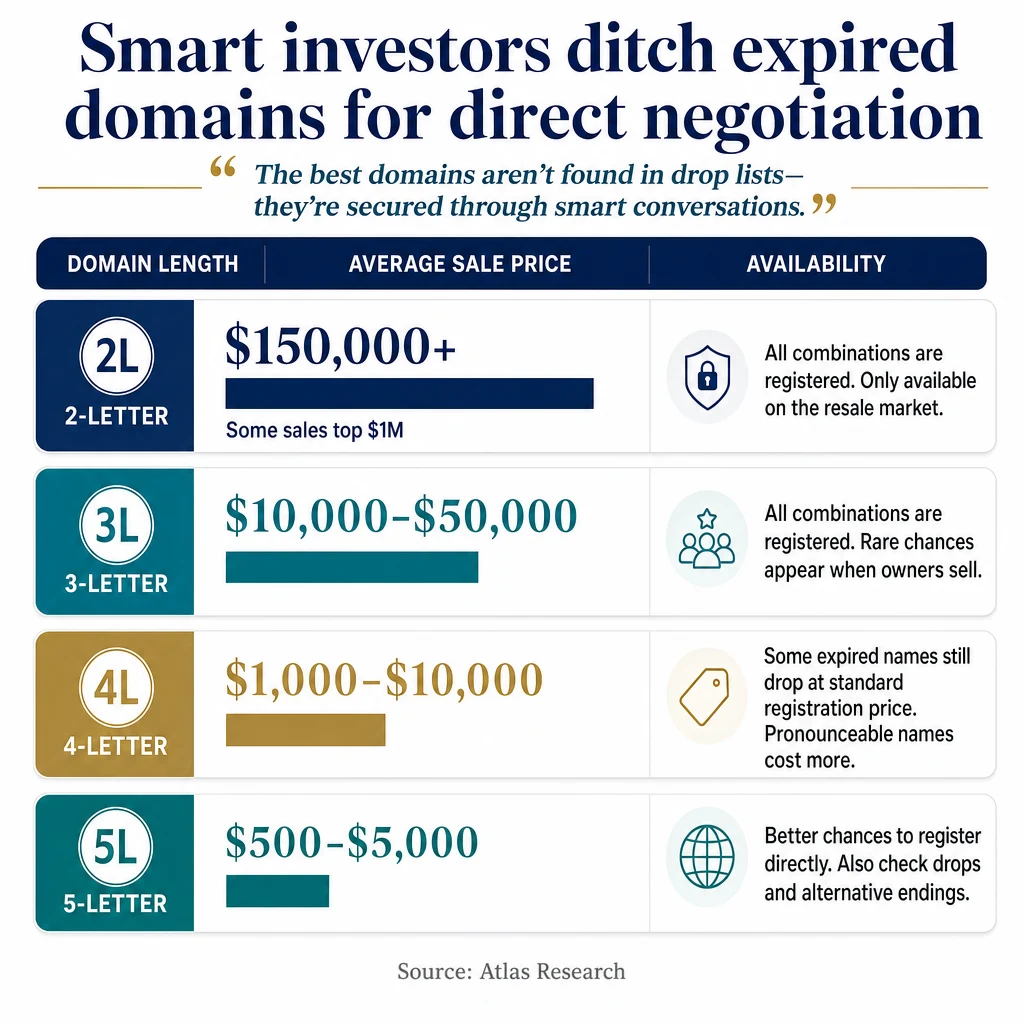
| Domain Length | Average .com Sale Price | Availability Notes |
|---|---|---|
| 2-letter | $150,000+ (some over $1M) | All combinations registered; aftermarket only |
| 3-letter | $10,000-$50,000 | All combinations registered; rare hand-registration opportunities |
| 4-letter | $1,000-$10,000 | Some drops available at standard price; pronounceable names command premium |
| 5-letter | $500-$5,000 | Better hand-registration availability; check drops and alternative TLDs |