


Picture a Tuesday morning in early 2026. A sales development representative at a mid-sized software company sits down to build her prospecting list for the week. Three years ago, this task would have consumed her entire morning scrolling through LinkedIn, cross-referencing company databases, verifying email addresses, and manually entering data into her CRM. Today, she uploads a list of 500 target companies to an AI-powered data extraction tool, and within twelve minutes, she has verified business emails, phone numbers, and social media profiles for every contact on her list. The remaining four hours of her morning are spent on what actually drives revenue: personalized outreach and qualified conversations.
This is not a vision of some distant future. It is the daily reality for sales teams that have embraced AI-powered lead generation tools, and it represents one of the most significant operational shifts in B2B sales methodology since the advent of customer relationship management software in the 1990s.

How AI-Powered Lead Generation Actually Works
At its core, AI-powered lead generation replaces the manual, repetitive tasks of prospecting research, data collection, contact verification, and initial qualification with automated systems that can process vast amounts of information in seconds. The technology draws on machine learning algorithms trained to identify patterns in business data, predict which contacts are most likely to convert, and continuously refine its recommendations based on engagement metrics.
According to Salesgenie's comprehensive guide to buying business leads in 2025, modern lead generation platforms typically provide databases containing millions of verified contacts that sales teams can filter by industry, job title, company size, location, and other firmographic criteria. The guide notes that these platforms "provide databases of business contacts, often including emails, phone numbers, and firmographic details" and enable teams to "skip the manual research and focus on meaningful conversations."
The AI layer adds several sophisticated capabilities to this foundational database approach. First, there is data extraction the ability to pull contact information automatically from lists of websites. BulkLeads' product suite, for example, allows users to upload a list of domains and extract emails, social media URLs, usernames, and phone numbers across all pages of each website, with results downloadable as Excel reports. This capability transforms a manual research task that might take hours into a fully automated process completing in minutes.
Second, AI-powered email finding tools can take partial information a contact's first name, last name, and company domain and reconstruct likely email addresses using pattern recognition. The BulkLeads platform describes this as building "emails from patterns" based on formats like first.last@company.com, enabling users to "find valid emails from 3 data points."
Third, lead enrichment functionality fills gaps in existing contact records by appending missing firmographic data company size, revenue figures, technology stack, recent funding rounds transforming thin prospect records into actionable intelligence. This enrichment process is particularly valuable for teams that have accumulated years of contact lists with outdated or incomplete information.
Fourth, chatbot-based capture represents a proactive approach to lead generation that operates continuously, even when sales teams are offline. These AI-powered conversational interfaces can engage website visitors, qualify their interests through targeted questioning, and route qualified leads directly into CRM systems or notification channels like Slack.
The Tools Landscape: Comparing AI Lead Generation Platforms
The market for AI-powered lead generation tools has matured significantly, with platforms now offering comprehensive suites that consolidate multiple functions under a single subscription. Understanding the pricing structure and feature sets of leading providers helps sales leaders make informed decisions about where to invest their prospecting budgets.
BulkLeads' pricing structure illustrates the unlimited-access model that has become increasingly popular among SMB-focused platforms. Their Business Plan, priced at $49 per month per user, provides unlimited access to enrichment features, data extraction, email finding, chatbot deployment, review management, email sequences, email verification, social proof widgets, and B2B social media lead extraction. The Enterprise Plan, at $99 per month for five users, extends these capabilities with increased limits on social proof notifications and similar features.
For comparison, Salesgenie offers tiered pricing ranging from $99 per month for a basic plan to $299 per month for team access, with access to over 25 million business contacts and 245 million consumer records. Their platform emphasizes data accuracy guarantees, offering credit refunds for outdated contacts a feature that addresses one of the persistent pain points in purchased lead data.
ListShack, another competitor in the space, positions itself as an accessible option for small businesses and independent salespeople, with pricing starting at $50 per month. Their platform emphasizes ease of use, offering geographic and map-based search tools alongside traditional filtering capabilities. According to their public materials, ListShack has served over 2,400 customers and facilitates approximately 9 million lead downloads per month across their database of 451 million available records.
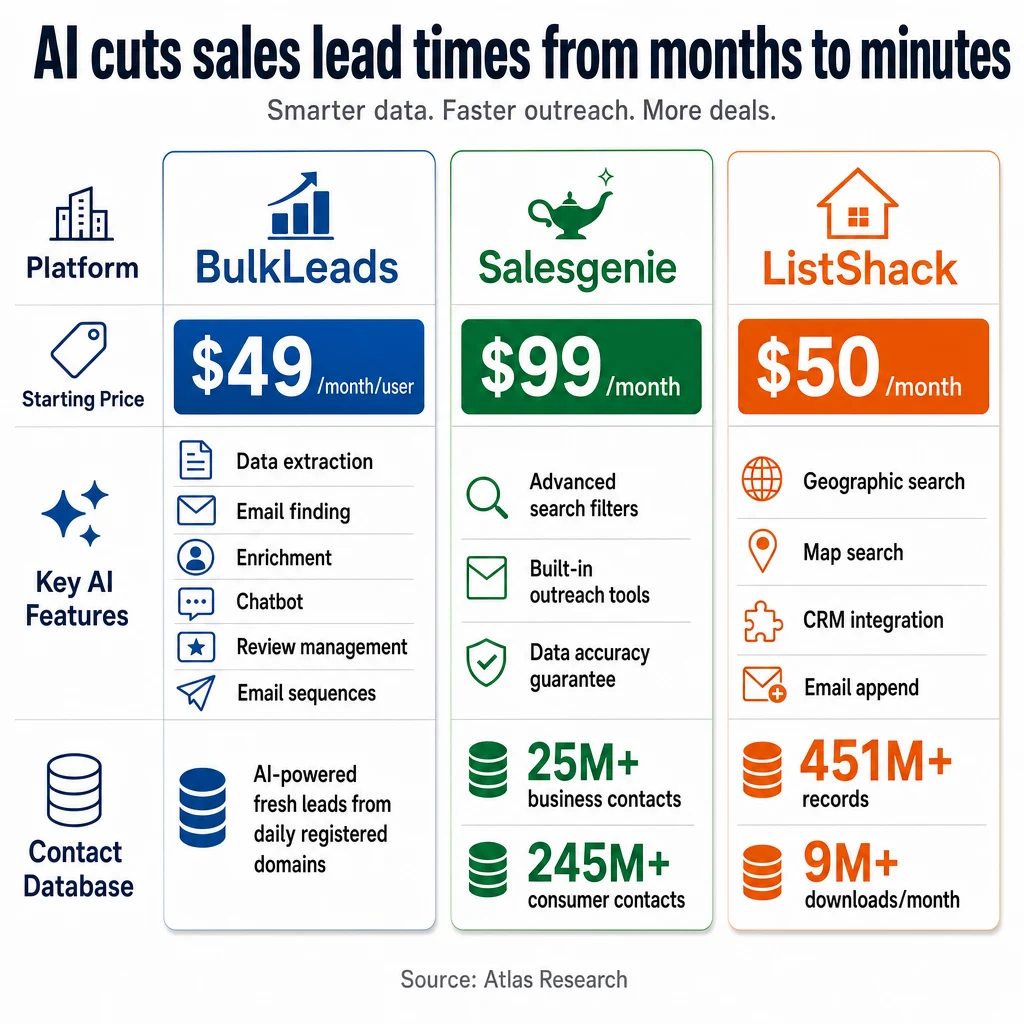
| Platform | Starting Price | Key AI Features | Contact Database |
|---|---|---|---|
| BulkLeads | $49/month/user | Data extraction, email finding, enrichment, chatbot, review management, email sequences | AI-powered fresh leads from daily registered domains |
| Salesgenie | $99/month | Advanced search filters, built-in outreach tools, data accuracy guarantee | 25M+ business, 245M+ consumer contacts |
| ListShack | $50/month | Geographic search, map search, CRM integration, email append | 451M+ records, 9M+ downloads/month |
What emerges from this comparison is a market that has evolved beyond simple list sales toward integrated platforms combining multiple AI-powered functions. The unlimited-access pricing model, particularly evident in BulkLeads' approach, reflects a broader shift away from per-contact pricing toward value-based subscriptions that align vendor revenue with customer success.
How AI Improves Lead Quality Beyond Simple Volume
A common misconception about AI-powered lead generation is that its primary value lies in volume generating more contacts faster. While speed and scale are certainly advantages, the more transformative impact of AI on lead quality comes from its ability to enrich prospect data with contextual intelligence that enables more personalized, relevant outreach.
Traditional lead generation often relied on purchased lists containing basic contact information: name, title, company, email, phone. This data, however, quickly becomes stale. People change jobs, companies evolve their technology stacks, and firmographic details like employee count or revenue figures shift with market conditions. Sales teams using outdated data often find themselves reaching out to contacts who have moved on, targeting companies that no longer match their ideal customer profile, or sending generic messages that fail to resonate because they lack contextual relevance.
AI-powered enrichment addresses this problem by continuously updating prospect records with fresh data. BulkLeads' enrichment functionality, for example, is designed to "find new leads (emails)" and provides "daily registered domains with leads information," enabling sales teams to target companies that have recently entered the market rather than relying on static databases of established businesses.
The quality improvement extends beyond data freshness to include behavioral and intent signals. Modern AI platforms can analyze patterns in how prospects interact with content, track website engagement, and identify companies actively researching solutions in specific categories. This intent data allows sales teams to prioritize outreach to prospects who are actively in-market rather than those who may never have considered a purchase.
Furthermore, AI-powered chatbots and social proof widgets add a qualification layer that traditional list-based approaches lack entirely. By engaging prospects in conversational interactions before human contact, these tools can capture stated needs, budget indicators, and timeline information that enables sales teams to focus their efforts on the most promising opportunities.
Is AI Lead Generation Better Than Traditional Methods?
The question of whether AI-powered lead generation outperforms traditional methods is not really a question of technology it is a question of economics and opportunity cost. Traditional prospecting methods, including purchased lists, cold calling from directories, and manual LinkedIn research, still produce results. The relevant comparison is not whether AI is better in some absolute sense, but whether the efficiency gains and quality improvements justify the investment for a given sales organization.
For high-volume prospecting operations, the case for AI is compelling. A sales team that previously spent 60% of their time on research and data entry can redirect that time toward actual selling activities when AI handles the foundational work. The math is straightforward: if a sales development representative earns $60,000 annually and spends half their time on research tasks that AI could automate, the organization is effectively paying $30,000 per year for work that produces no direct revenue. Deploying a $49-per-month AI tool to handle that work represents a significant return on investment.
For lower-volume, high-touch sales organizations, the calculus may differ. Enterprise sales teams that close six-figure deals may prioritize relationship-building over prospecting efficiency, and their ideal customer profile may be so specific that AI-generated leads offer limited advantage over carefully curated networks and referrals. However, even these organizations can benefit from AI's ability to enrich existing relationships with additional context and to identify decision-makers within target accounts.
The Salesgenie guide to buying business leads captures this nuance well, noting that purchasing leads "lets you skip the manual research and focus on meaningful conversations." The emphasis on meaningful conversations rather than raw contact volume reflects an industry-wide recognition that lead generation's ultimate purpose is not data collection but relationship initiation.

How to Use AI to Find B2B Leads: A Practical Framework
Translating AI lead generation capabilities into a practical prospecting workflow requires more than tool deployment it requires strategic thinking about target customer profiles, data quality management, and integration with existing sales processes.
The first step is defining the ideal customer profile with sufficient specificity to enable AI-powered filtering. Generic targeting criteria like "technology companies" or "business services firms" produce lists that are too broad to be useful. More effective profiles include firmographic details like employee count ranges, revenue brackets, technology stack indicators, and geographic concentration. They also include psychographic signals like funding stage, recent leadership changes, or expansion announcements that indicate a company may be in-market for new solutions.
Once the ideal customer profile is defined, the next step is selecting the appropriate AI tools for data collection. BulkLeads' platform overview illustrates the modular nature of modern AI tools, offering separate functionalities for data extraction, email finding, enrichment, and chatbot capture. Sales teams should evaluate which of these capabilities address their most significant prospecting bottlenecks whether that is finding contact information, verifying data accuracy, or capturing leads from website traffic.
The third step is establishing data hygiene protocols. AI-generated leads are only as good as the processes that maintain them. This includes regular enrichment cycles to update stale records, verification checks before outreach to catch bounced emails and disconnected numbers, and CRM integration to ensure that prospect interactions are logged and accessible to the full sales team.
The fourth step is designing outreach sequences that leverage AI-generated insights. Rather than sending generic cold emails, sales teams can use the enriched data points that AI provides recent funding, technology adoption, leadership changes to craft messages that demonstrate genuine understanding of the prospect's situation. BulkLeads' email sequence functionality supports this approach by enabling "sales sequence (cadence) / newsletter campaigns with unlimited emails to send," allowing teams to test multiple message variations and optimize based on response rates.
Can AI Automate the Entire Sales Prospecting Process?
The vision of fully automated prospecting where AI identifies, qualifies, engages, and books meetings with zero human involvement remains more aspiration than reality. However, AI has advanced sufficiently to handle the majority of prospecting tasks that previously required human time, leaving sales professionals to focus on the relationship-building activities where human judgment and emotional intelligence remain essential.
What AI handles well: initial research and data collection, contact verification and enrichment, email deliverability checking, chatbot-based initial engagement, meeting scheduling for qualified leads, and performance analytics that identify which prospecting tactics are producing results.
What AI cannot yet replicate: understanding nuanced buyer objections, building trust through genuine relationship investment, navigating complex organizational dynamics, and closing deals that require creative problem-solving and personal credibility.
The practical implication is that AI transforms the sales prospecting role from a research-and-data-entry function into a relationship management function. Sales development representatives who previously spent most of their time building lists now spend most of their time in conversations. This shift requires different skills emotional intelligence, active listening, consultative questioning and produces different outcomes, with sales teams reporting higher quality conversations and improved conversion rates when AI handles the foundational work.
BulkLeads' comprehensive tool suite reflects this reality, offering AI-powered capabilities across the entire prospecting workflow while acknowledging that human judgment remains central to conversion. Their platform combines data extraction, email finding, enrichment, and chatbot capture with email sequences and review management covering the full spectrum from initial contact through ongoing relationship management.
What This Means for BulkLeads Readers
For readers evaluating AI-powered lead generation tools, the current market offers more choice and better functionality than ever before, but also more complexity. The proliferation of platforms with overlapping feature sets makes it essential to identify which specific prospecting bottlenecks are costing your team the most time or producing the lowest quality leads.
If your primary challenge is contact data finding accurate emails, phone numbers, and social profiles for target accounts invest in platforms with strong data extraction and email finding capabilities. If your challenge is data quality working with outdated or incomplete records prioritize enrichment functionality that can append missing firmographic details. If your challenge is lead capture converting website traffic into actionable prospects focus on chatbot and social proof tools that engage visitors before they leave.
The unlimited-access pricing model adopted by platforms like BulkLeads reflects a broader industry recognition that lead generation is not a one-time purchase but an ongoing operational function. Rather than paying per contact and watching costs scale linearly with prospecting volume, teams can subscribe to platforms that provide comprehensive functionality for predictable monthly fees.
Ultimately, the measure of AI lead generation success is not the number of contacts generated or the speed of data collection it is the quality of conversations that result. When AI handles the research and data work that previously consumed sales professionals' time, those professionals can focus on the relationship-building activities that actually close deals. The technology is a means to an end, not an end in itself.
Where to Read Further
For readers seeking to explore AI-powered lead generation tools and strategies in greater depth, the following resources provide additional context and comparison data:
- Salesgenie's comprehensive guide comparing 20+ business lead providers offers detailed feature analysis, pricing comparisons, and practical advice for selecting lead generation platforms.
- BulkLeads' official product documentation provides in-depth descriptions of their ten AI-powered tools, including data extraction, email finding, chatbot capture, and enrichment capabilities.
- BulkLeads' pricing and plan details enable direct comparison between Business and Enterprise tiers for teams evaluating subscription options.
- ListShack's sales lead database offers an alternative perspective on lead generation tools, with emphasis on geographic search and SMB accessibility.
The landscape of AI-powered sales prospecting continues to evolve rapidly. Teams that invest time now in understanding these tools and integrating them into their workflows will be better positioned to adapt as the technology advances further. The goal is not to adopt AI for its own sake, but to redirect human time and talent toward the relationship-building work that ultimately drives revenue.