The room where the deal gets built
Inside a construction site in West Virginia, workers are pushing toward a deadline that depends on money that does not yet exist. The site belongs to Nscale, a UK-based neocloud provider that signed a six-year, roughly $45 billion compute agreement with Anthropic in August 2026. The first 460-megawatt building at Nscale's Monarch Compute Campus is expected to come online in late 2027, running on Nvidia's next-generation Vera Rubin chips. A second building of the same size is still being negotiated. And the financing for that second phase is the subject of talks that have drawn attention across the AI industry and Wall Street alike.
Nvidia is in talks to guarantee billions of dollars of debt that Nscale would raise to build that second phase, according to reporting by TechCrunch and corroborated by Bloomberg. The guarantee would not be a first. Nvidia already supplies Nscale's chips, has committed $1 billion to the company's pre-IPO convertible financing, and guaranteed approximately $860 million of Nscale's lease obligations in Texas around October 2025. Now, as Nscale pursues a public listing on the New York Stock Exchange under the ticker NSCL, Nvidia may add another layer: a residual value guarantee that steps in if Nscale defaults on construction payments.
What a residual value guarantee actually does
A credit guarantee works like a co-signer on a mortgage. If the borrower stumbles, lenders can turn to the deep-pocketed backer. In the case of a residual value guarantee specifically, Nvidia would step in if Nscale defaulted on construction payments, temporarily take over the facility, and help find a buyer and new tenant, according to The Information. This is a more direct form of construction exposure than Nvidia's earlier support, which mostly covered leases and chip purchases.
The structure matters because it changes what lenders are actually underwriting. When Nvidia stands behind a borrower, the credit risk on the debt instrument is partly a function of Nvidia's own guarantee discipline and balance sheet not just Nscale's revenue curve. That creates a layered dependency that analysts have begun to call circular financing: Nvidia creates demand for its chips by helping customers afford the infrastructure to run them, then backs the financing so those customers can keep buying.
The $45 billion Anthropic deal and the financing gap
Anthropic agreed on August 25 to pay Nscale up to about $44.6 billion for computing at Nscale's Monarch Compute Campus in West Virginia, according to Nscale's IPO filing. The agreements cover Nvidia Vera Rubin NVL72 systems, delivered in four tranches. That is the largest single contract in Nscale's portfolio and the filing reveals something important about the financing picture.
In that September 18 filing, Nscale said it had "not obtained binding commitments for any of the financings required to fund performance under the Anthropic Services Agreements." The contract requires Nscale to use best efforts to line up that financing within a specified period. "There can be no assurance that we will obtain any of the required financings on acceptable terms or at all," the filing says.
That gap is the opening Nvidia's proposed guarantee would fill. Anthropic is also in talks for a second deal worth roughly $45 billion, covering another 460-megawatt building at the same campus. The reporting does not yet make clear which of the two Anthropic projects at Nscale's West Virginia campus the proposed debt guarantee would fund.
Nvidia's accumulated exposure across the neocloud sector
The scale of Nvidia's financial involvement across the neocloud sector is substantial. Nvidia disclosed as much as $164.5 billion in customer-support commitments in its July 2026 10-Q, and press accounts place the total exposure for neoclouds above $170 billion once direct investments and equity stakes are counted. In its latest quarterly report for the period ended July 26, Nvidia said it had guaranteed select AI cloud partners' data center lease obligations in the event of their default, with maximum gross exposure under those agreements at $3.5 billion. In August, Nvidia also agreed to guarantees capped at $105 billion for leases at SB Energy, according to the same filing.
Nvidia guaranteed roughly $860.3 million of Nscale's payments on a Texas data center lease for its first five years, the IPO filing shows. Nscale gave Nvidia warrants valued at $60 million in return, and it keeps $470 million in an escrow account as recourse for Nvidia. Nvidia also committed $1 billion to Nscale's $3.36 billion pre-IPO convertible financing, with funding expected in mid-November. The notes convert into shares automatically when Nscale goes public, and Nvidia's convert into non-voting shares.
Nscale itself showed $103.4 billion in total contracted value in its September S-1, against $2.6 billion in active revenue, after closing roughly $3 billion in senior secured delayed-draw term loan facilities in August 2026 to fund specific GPU deployments. The company is seeking to list at a valuation of up to $35 billion.
The circular financing question
The arrangement has revived concerns about circular financing in the AI buildout. As InvestingLive noted in its coverage of the talks, "Nvidia already sells the chips and owns a stake in the landlord. Now it may co-sign the mortgage too." That line captures the geometry plainly: Nvidia holds three roles in the same deal chip supplier, equity investor, and potential debt guarantor concentrating all forms of exposure on one party.
Lenders pricing Nscale's debt paper must simultaneously underwrite Anthropic's revenue curve and Nvidia's guarantee discipline, with neither fully disclosed until Anthropic files to go public. The circular nature of the arrangement means Nvidia's chip sales generate the demand that justifies the financing, while the financing ensures customers can keep buying. Whether that constitutes a structural risk or simply efficient capital allocation depends on who is asking.
For Nvidia, the trade-off is concrete. The company benefits from locking in demand for its next-generation Vera Rubin chips. But it takes on contingent credit risk tied to a pre-IPO company with $2.6 billion in active revenue against $103.4 billion in contracted value a ratio that invites questions about delivery timelines and customer concentration.
Why the guarantees matter for smaller developers
There is a counterintuitive argument in favor of the guarantee structure. Guarantees from a highly rated supplier like Nvidia could narrow the spreads that smaller data center developers pay to borrow, easing one of the funding strains markets have been worrying about. If Nvidia's backstop reduces perceived credit risk on Nscale's paper, it could establish a pricing benchmark that flows through to other borrowers in the sector.
Nscale's planned IPO could benefit from the added backing, though investors are likely to ask how much of its revenue depends on financing from its own supplier. The question is not whether the structure works in the best case it is what happens when the best case does not arrive on schedule.
Nscale's operational track record and the West Virginia site
The West Virginia project has faced real headwinds. The construction site has experienced runoff that flooded nearby homes more than once, according to TechCrunch's reporting. In September, after months of negotiations, the project won state certification. This month, Microsoft pulled out of a planned Nscale site in England after grid power for it was pushed into the 2030s.
Nscale had about 25,000 advanced AI chips running in August 2026, a fraction of the nearly 500,000 it plans to deploy. That gap between ambition and execution is part of what the IPO process is meant to address by bringing public market scrutiny and capital to bear on a company that has been building at a pace its own financing has struggled to keep up with.
What this means for Nvidia, Nscale, and Anthropic readers
For readers tracking the AI infrastructure buildout, the Nvidia-Nscale-Anthropic arrangement illustrates how the boundaries between supplier, investor, and financier have blurred at the frontier of AI computing. Nvidia's willingness to guarantee debt reflects confidence in the long-term demand for compute but it also concentrates risk in ways that are not fully visible until quarterly filings or IPO prospectuses surface them.
The arrangement also shows how neoclouds like Nscale are navigating the gap between contracted revenue and required capital expenditure. With $103.4 billion in contracted value against $2.6 billion in active revenue, the business model depends on delivery at scale and delivery at scale depends on financing that is not yet fully committed. Nvidia's proposed guarantee addresses that gap directly, at least for the second phase of the West Virginia campus.
For Anthropic, the arrangement insulates the compute agreement from Nscale's financing risk assuming the guarantee closes. Anthropic gets its 460 megawatts of Vera Rubin capacity with Nvidia effectively standing behind the infrastructure that delivers it.
Jensen Huang's directness on neocloud demand
On Nvidia's willingness to keep writing these checks, Jensen Huang has not been subtle. In remarks covered by AI Weekly's reporting on the guarantee talks, Huang described the demand for neocloud capacity as extraordinary. That demand is what justifies the guarantee structure: if the compute sells, the debt gets repaid, and Nvidia's exposure never crystallizes. The question is whether the demand materializes fast enough and at sufficient scale to justify a $45 billion contracted value against a current revenue base measured in billions.
The deal hasn't been signed, and the terms could still change. But the structure is becoming clearer: Nvidia as chip supplier, Nvidia as equity investor, Nvidia as the backstop that makes the whole arrangement financeable. That triple role is not unusual in capital-intensive industries it appears in aerospace, energy, and infrastructure routinely but at the scale of AI compute, with valuations approaching $35 billion for companies with modest current revenue, the dynamics are being watched closely by lenders, investors, and regulators alike.
Where to read further
The primary documents to watch are Nscale's IPO filing, dated September 18, which discloses the Anthropic Services Agreements and the absence of binding financing commitments, and Nvidia's July 2026 10-Q, which details the $164.5 billion in customer-support commitments and the $3.5 billion in maximum gross exposure under lease guarantee agreements. Reporting from TechCrunch, AI Weekly, and AI Stockwire has traced the timeline of Nvidia's involvement from the October 2025 Texas lease guarantee through the August 2026 Anthropic compute agreement to the October 2026 guarantee talks.
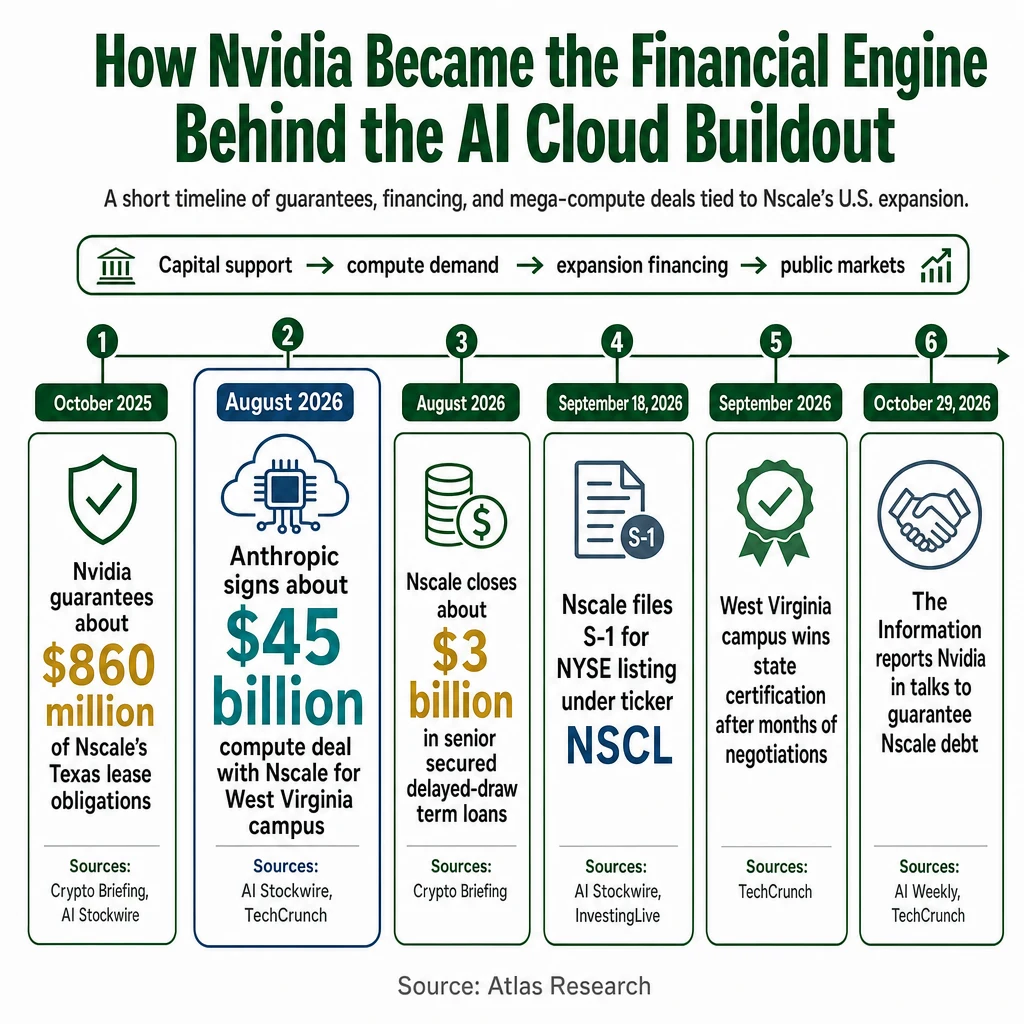
| Date | Event | Source |
|---|---|---|
| October 2025 | Nvidia guarantees ~$860 million of Nscale's Texas lease obligations | Crypto Briefing, AI Stockwire |
| August 2026 | Anthropic signs ~$45 billion compute deal with Nscale for West Virginia campus | AI Stockwire, TechCrunch |
| August 2026 | Nscale closes ~$3 billion in senior secured delayed-draw term loans | Crypto Briefing |
| September 18, 2026 | Nscale files S-1 for NYSE listing under ticker NSCL | AI Stockwire, InvestingLive |
| September 2026 | West Virginia campus wins state certification after months of negotiations | TechCrunch |
| October 29, 2026 | The Information reports Nvidia in talks to guarantee Nscale debt | AI Weekly, TechCrunch |
Whether the guarantee closes or the terms shift, the structure Nvidia is building with Nscale and Anthropic is a template worth understanding one where the chipmaker's balance sheet does the work that market discipline alone cannot yet support at the scale the AI buildout requires.