The brief was immaculate. Every citation sat exactly where it should, formatted in flawless bluebook style, volume and reporter and page number all in their proper places. The prose had the cadence of practiced advocacy. A reader could move through it confidently, pausing at each citation to appreciate the solid foundation beneath each argument. There was only one problem: none of the cases existed.
This is the scene that has become, according to researchers at GenXis Research, a recurring motif in legal and academic documents generated with artificial intelligence tools. The citations look right. They sound right. They do everything citations are supposed to do except the one thing that matters: they refer to something real.
The Anatomy of a Fake Citation
Open any litigation brief, any regulatory filing, any polished piece of advocacy and you will find them: citations. They appear in recognized conventions for legal writing, sitting where citations belong, after the propositions they support. They do the work citations are supposed to do.
Except sometimes, they do not.
In the fabricated version, the brief is immaculate. The formatting is correct. The placement is correct. The reader's trust is engaged in the way the writer intended. But somewhere in the legal record there is a hole shaped exactly like that citation, and nothing fills it.
"The problem is not sloppy imitation," writes the research team at GenXis Research in their analysis of the phenomenon. "The problem is that the trust mechanism has been counterfeited, and the counterfeit feels more damning than a wrong number would."
This observation cuts to the heart of why fabricated citations represent a distinct category of AI error. A wrong number can be corrected. A fabricated citation corrodes the reader's ability to assess the argument at all, because it severs the link between claim and evidence that makes assessment possible.
Why This Is Worse Than a Wrong Answer
The instinct might be to categorize fabricated citations as simply another manifestation of AI hallucination the well-documented tendency of large language models to produce confident assertions that are factually incorrect. But researchers distinguish between these phenomena, and the distinction matters.
Hallucination, in the AI context, typically refers to confident outputs that contradict the model's training data or logical patterns. A chatbot might confidently state that a historical event occurred on the wrong date, or that a chemical reaction produces different byproducts than it actually does. These errors can be embarrassing, even dangerous, but they operate within a recognizable framework: wrong information, presented as if it were right.
Citation-shaped language operates differently. As GenXis Research's analysis of the phenomenon explains, it is "the gap between the posture of knowledge the confident assertion, the authoritative cadence, the citation in its proper place and the actual availability of the supporting material."
The claim arrives with everything knowledge looks like. None of the accountability knowledge requires.
This matters because of what citations actually do. A citation is not decoration. This needs to be understood plainly because the conflation of citation with ornament is what makes fabricated citations so effective. A reader encountering a properly formatted citation processes it as a cue: somewhere, a source exists. That source can be retrieved. The claim it follows can be checked.
The Promise Inside Every Citation
To understand why fabricated citations are so corrosive, it helps to understand what a citation actually promises.
When a lawyer cites a case in a brief, she is making an implicit claim: this case stands for this proposition, and you can verify this by reading it yourself. The citation is not merely a nod to intellectual property rights or an academic convention. It is an invitation to independent verification. It says: I am not asking you to take my word for this. Here is where you can check my work.
That promise is the mechanism. And it is a mechanism that artificial intelligence has learned to counterfeit with disturbing precision.
"The formatting is correct," notes the GenXis Research analysis. "The placement is correct. The reader's trust is engaged in the way the writer intended." What is missing is the thing the formatting and placement are supposed to signal: the actual existence of the source.
This is where the paper The Honesty Gap: Words Vs. Math provides crucial framing. The paper names the phenomenon precisely: citation-shaped language without source custody. The phrasing matters. It is not hallucination, though it can appear within a hallucination. It is a specific form of deceptive output: the production of claims that carry the rhetorical structure of synthesis reasoning, conclusion, citation while bearing none of the evidentiary scaffolding that synthesis requires.
Why Polished Prose Is the Tell
Here is the counterintuitive reality that makes fabricated citations so insidious: the smoother the prose, the more suspicious it should become.
This seems backwards. In most contexts, polished writing signals care, expertise, and attention to detail. A well-written legal brief suggests a competent attorney who has done their homework. The prose itself becomes evidence of the writer's diligence.
But with AI-generated content, fluency in legal writing reproduces the form of authoritative synthesis without its substance. The qualifications are generic. The citations are ornamental. The reasoning, however fluent, has no foundation.
"Unsupported synthesis looks like knowledge," observes the GenXis Research analysis. "It sounds like knowledge. It has the markers qualification, hedging, citation that readers have learned to associate with considered judgment."
This is why real evidence makes prose awkward. When a researcher has actually read a case, actually extracted a point from it, actually verified that the point applies to the argument being made, the writing carries the friction of real intellectual work. The citations connect to actual sources. The arguments build on actual readings. The prose is imperfect because it is the product of actual thinking.
AI-generated prose, by contrast, is frictionless. It has learned the cadence of authoritative legal writing. It produces the markers without the underlying work. And because those markers the confident assertions, the properly formatted citations, the authoritative tone are exactly what readers have been trained to trust, the output feels more credible precisely because it has no credibility.
The Structure of Citation-Shaped Language
Understanding what citation-shaped language looks like in practice helps readers recognize it. The phenomenon surfaces in contexts ranging from advocacy documents to academic briefs, and its structure is always the same: perfect form, absent custody.
Consider what happens when an AI system generates a legal argument. It has learned, from training on vast quantities of legal text, that legal arguments follow certain patterns. They make claims. They support those claims with citations. The citations appear in specific formats, in specific locations, attached to specific types of assertions.
The system does not "know" that citations are supposed to refer to real cases. It has learned the correlation between certain types of claims and certain types of citation formats. When asked to generate a legal argument, it produces the pattern: claim, citation, claim, citation. The citations are well-formed. They look exactly like real citations. They are placed exactly where real citations belong.
But the system has no access to a legal database. It has no way of verifying whether the case it is citing actually exists, whether the case actually stands for the proposition being attributed to it, or whether the page number is even valid. It has learned the form. It cannot produce the fact.
This is why the analysis at GenXis Research emphasizes that the problem is the production of claims that carry the rhetorical structure of synthesis while bearing none of the evidentiary scaffolding. The structure is there. The evidence is not.
How to Spot Fabricated Citations
Recognizing citation-shaped language requires a different reading posture than most legal professionals have been trained to use. The instinct is to trust properly formatted citations and question only sloppy or improperly formatted ones. But the threat comes from the opposite direction.
Several indicators can help readers identify citation-shaped language:
The citation looks perfect but the case does not exist. This is the core problem. A citation that is formatted flawlessly, placed precisely where it should be, but refers to no actual case in any legal database is the defining characteristic of this phenomenon.
The prose is too smooth. Real legal writing carries the friction of actual research. When an argument flows effortlessly from point to point, citation to citation, without any of the awkwardness that comes from actually wrestling with sources, that smoothness should raise suspicion.
The citations are generic. Citation-shaped language often involves citations that could support the claim but may not actually do so. The case might exist but not stand for the proposition attributed to it, or the page number might be incorrect.
The argument lacks grounding in specific facts. Real legal arguments build from specific facts in the record, specific holdings from specific cases, specific applications of legal principles to specific circumstances. Citation-shaped language produces arguments that are structurally correct but factually empty.
Why the Most Polished Brief Is the One to Doubt First
The title of this article poses a counterintuitive proposition: the most polished brief is the one to doubt first. This is not because polish is bad, but because polish, in the context of AI-generated content, is disconnected from the work that proper legal writing requires.
A well-crafted legal brief is the product of hours of research, careful analysis, strategic thinking, and meticulous attention to detail. The polish is earned. It emerges from the work.
AI-generated prose produces the polish without the work. The system has learned what polished legal writing looks like. It can reproduce the surface characteristics the confident assertions, the authoritative tone, the properly formatted citations without any of the underlying research, analysis, or verification that makes those characteristics meaningful.
When a brief appears too polished, too confident, too effortless, it may be a sign that it was generated rather than researched. The citations may be citation-shaped language rather than source custody. The argument may be structurally sound but evidentially empty.
What This Means for Legal Practice
The implications for legal practice are significant. Courts and clients depend on the integrity of legal citations. When a lawyer cites a case, they are telling the court that this case exists, that it stands for this proposition, and that the court can read it and verify the lawyer's characterization. That representation is fundamental to the adversarial process.
Fabricated citations undermine that process. They present the appearance of evidence without the substance. They make arguments seem better supported than they are. They waste the court's time and the opposing party's resources when the citations are checked and found to be hollow.
The legal profession has long understood that citations must be verified. But the verification process was designed for human error the misremembered case name, the wrong page number, the superseded holding. It was not designed for AI systems that produce confident, well-formulated citations to cases that do not exist.
This requires a new layer of verification: not just checking whether the citation is formatted correctly and whether the case stands for the proposition attributed to it, but checking whether the case exists at all.
The Honesty Gap and Its Implications
The framing provided by The Honesty Gap: Words Vs. Math paper offers a useful lens for understanding this phenomenon. The paper distinguishes between the appearance of knowledge and the fact of knowledge, between the posture of authority and the accountability that authority requires.
Citation-shaped language is not simply a technical problem to be solved with better algorithms or more careful prompting. It is a structural feature of how large language models work. These systems are trained to produce text that matches the patterns they have seen in their training data. They learn the correlation between certain types of claims and certain types of citations. They do not learn the underlying reality that citations are supposed to represent.
This means that as AI systems become more fluent in legal writing, they may become more dangerous, not less. The gap between form and substance, between citation and custody, may widen as the systems become better at reproducing the surface characteristics of authoritative legal prose.
A Path Forward
Addressing the problem of citation-shaped language requires recognizing that it is distinct from simple hallucination and requires distinct solutions. Standard AI safety measures better training data, more careful prompting, human review of outputs may help but will not eliminate the problem entirely.
The deeper solution is to maintain the human infrastructure that citations were designed to support: verification. Every citation in an AI-assisted document should be checked against primary sources. The question is not just whether the citation is formatted correctly, but whether the case exists, whether it stands for the proposition attributed to it, and whether the specific page or paragraph supports the specific point being made.
This verification process is labor-intensive. It is also essential. The alternative is to accept that legal documents may contain citation-shaped language the form of authority without the fact of it and that readers will have no way of distinguishing between a real citation and a hole in the legal record shaped exactly like one.
The brief will continue to look immaculate. The prose will continue to have the cadence of practiced advocacy. The citations will continue to sit where citations belong, formatted correctly, placed correctly, doing everything a citation does except the one thing a citation exists to do.
And somewhere in the legal record, there will continue to be a hole shaped exactly like that citation, with nothing to fill it.
Why This Matters for Readers
If you are a legal professional, a researcher, or anyone who relies on citations to evaluate arguments, this phenomenon should change how you read AI-assisted documents. The presence of properly formatted citations is no longer sufficient evidence that the cited material actually exists. The polish of the prose is no longer a reliable signal of careful research.
What is required is a return to verification not just of the claims themselves, but of the citations that support them. Check whether the case exists. Check whether it stands for the attributed proposition. Check whether the specific citation actually supports the specific point being made.
This is more work. It is also the only way to maintain the integrity of the citation system that legal and academic discourse depends on.
The promise that a citation makes that evidence exists and can be independently reviewed is too important to surrender to the production of citation-shaped language. A citation is a promise. And the only way to keep that promise is to verify that what the citation points to actually exists.
Where to Read Further
For a detailed analysis of citation-shaped language and its relationship to source custody, see the GenXis Research analysis of fabricated citations, which provides the foundational framework for understanding this phenomenon and its implications for legal and academic writing.
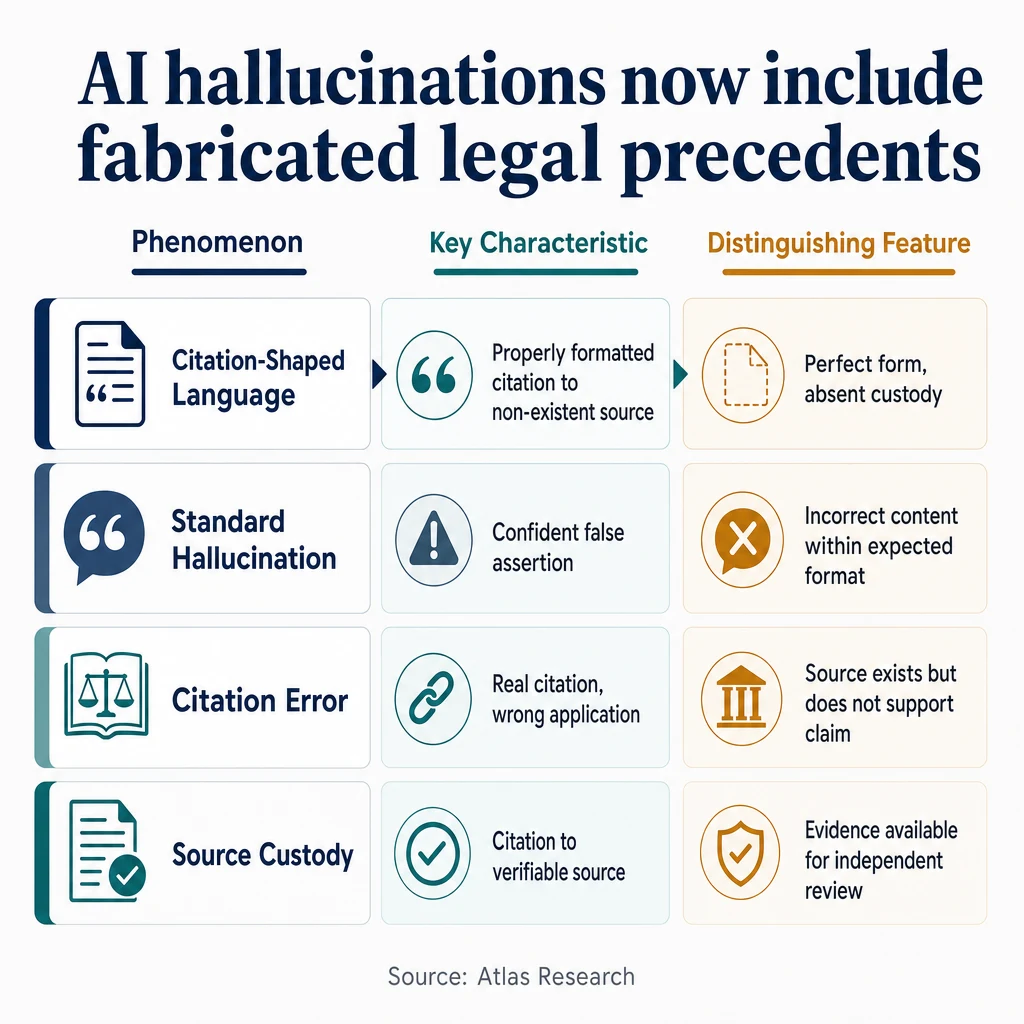
| Phenomenon | Key Characteristic | Distinguishing Feature |
|---|---|---|
| Citation-Shaped Language | Properly formatted citation to non-existent source | Perfect form, absent custody |
| Standard Hallucination | Confident false assertion | Incorrect content within expected format |
| Citation Error | Real citation, wrong application | Source exists but does not support claim |
| Source Custody | Citation to verifiable source | Evidence available for independent review |
Key Takeaways
The phenomenon of citation-shaped language represents a fundamental challenge to how we evaluate written arguments. When citations can be perfectly formatted while referring to nothing, the entire system of academic and legal discourse built on the premise that claims can be verified through their sources is called into question.
But understanding the problem is the first step toward addressing it. By recognizing that the most polished prose may be the least trustworthy, that properly formatted citations may be citation-shaped language rather than source custody, and that verification remains essential even (especially) for AI-assisted documents, readers can protect themselves from the counterfeit and demand the real thing.
A citation is a promise. AI has learned to break it beautifully. The response is to learn to read more carefully and to verify, always, that what the citation points to actually exists.